
Oliveira Lab Explores the Mechanisms Behind Biofilm Dispersion

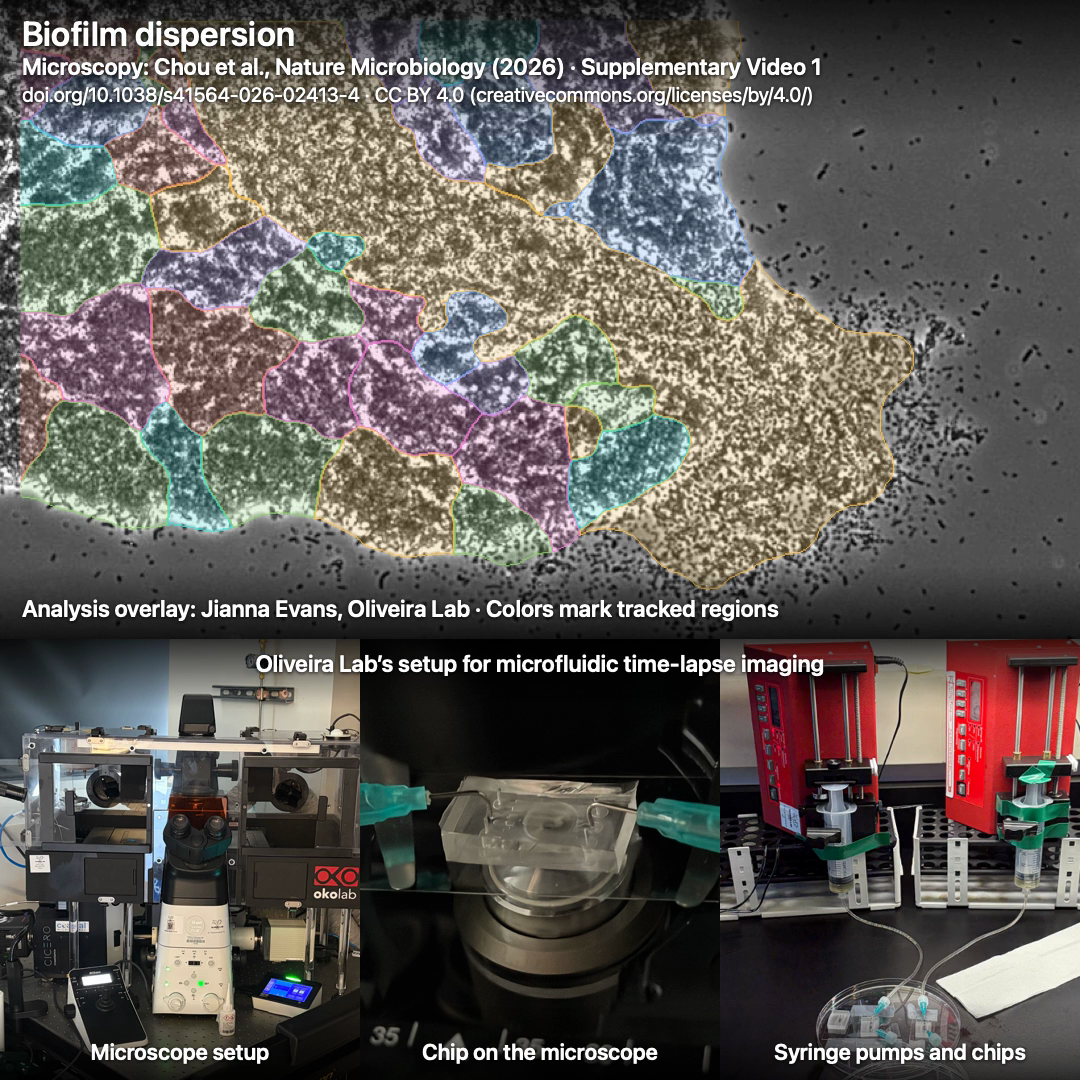
Two genetically identical bacteria can live side by side in a biofilm, yet one may leave while the other stays. What explains the difference?
At the Oliveira Lab, we’re studying biofilm dispersion, the process by which bacteria leave an established community. How do surroundings, biological history, and position shape dispersion? Can genetic tuning shift its timing or location?
As part of this research, Oliveira Lab graduate researcher Jianna Evans uses Partaker 2 to analyze time-lapse recordings of small clusters of bacteria called microcolonies. By measuring changes in their size and shape over time, Evans identifies when and where microcolonies begin to break apart and checks the footage for signs that bacteria have left.
To capture these changes, we use a pump to maintain controlled flow through a microfluidic chip mounted on a microscope. The microscope records the same region over time so we can look back at what happened before a release. Our published Partaker software provides a foundation for measuring cell shape and fluorescence at single-cell resolution in these recordings. Read the Partaker paper in Bioinformatics.
We’re interested in how cells respond to their surroundings. When a cell encounters a chemical cue, does it change how it grows, moves, or stays attached to the biofilm? Do genetically identical neighbors respond differently depending on their earlier growth or their position in the matrix that holds the biofilm together? Following individual cells over time can help us ask whether those responses give us clues about which cells will leave, when they’ll leave, and where dispersion will begin.
We thank DARPA for helping us build the experimental and computational capabilities behind this work through the Young Faculty Award and the Biological Technologies Office Director’s Nomination Fellowship. Oliveira Lab research sponsors.
Member comments
Sign in to join the discussion. Commenting is available to verified lab members. Account help.