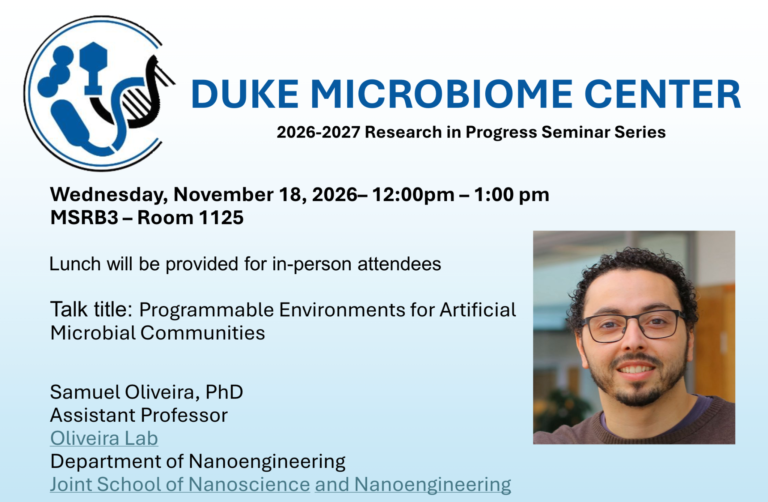
We are excited to share that Dr. Samuel Oliveira will present at the Duke Microbiome Center's 2026–2027 Research in Progress Seminar SeriesHis talk, "Programmable Environments for Artificial Microbial Communities," will explore the co-design of engineered microbial communities and programmable environments to investigate microbial growth, communication, and collective behavior. The presentation will highlight how microfluidic platforms, automated environmental control, and digital twin technologies can be integrated to design, study, and predict microbial community dynamics, advancing our
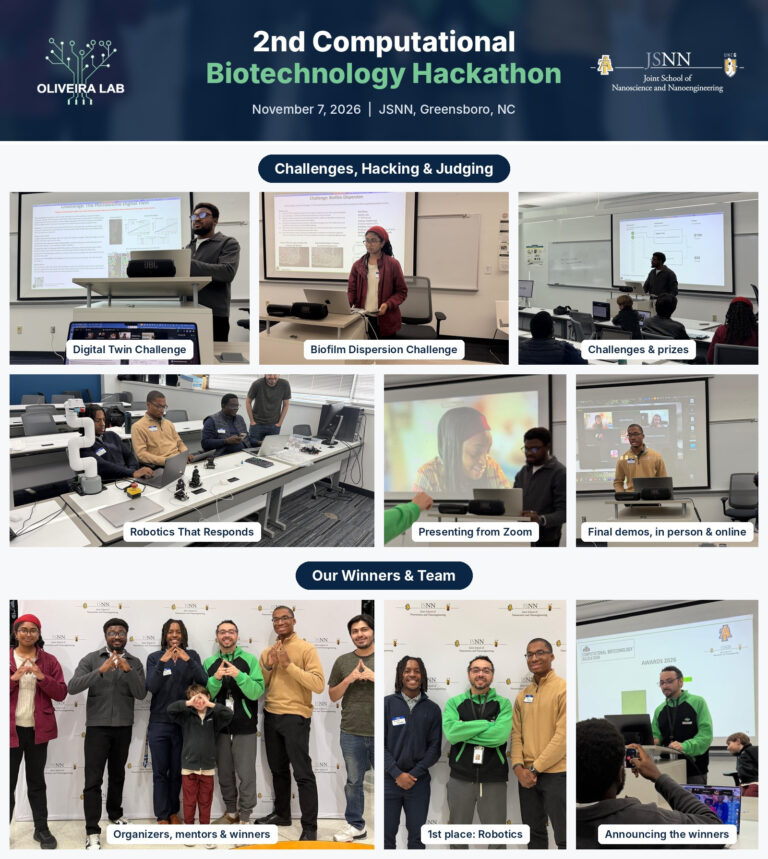
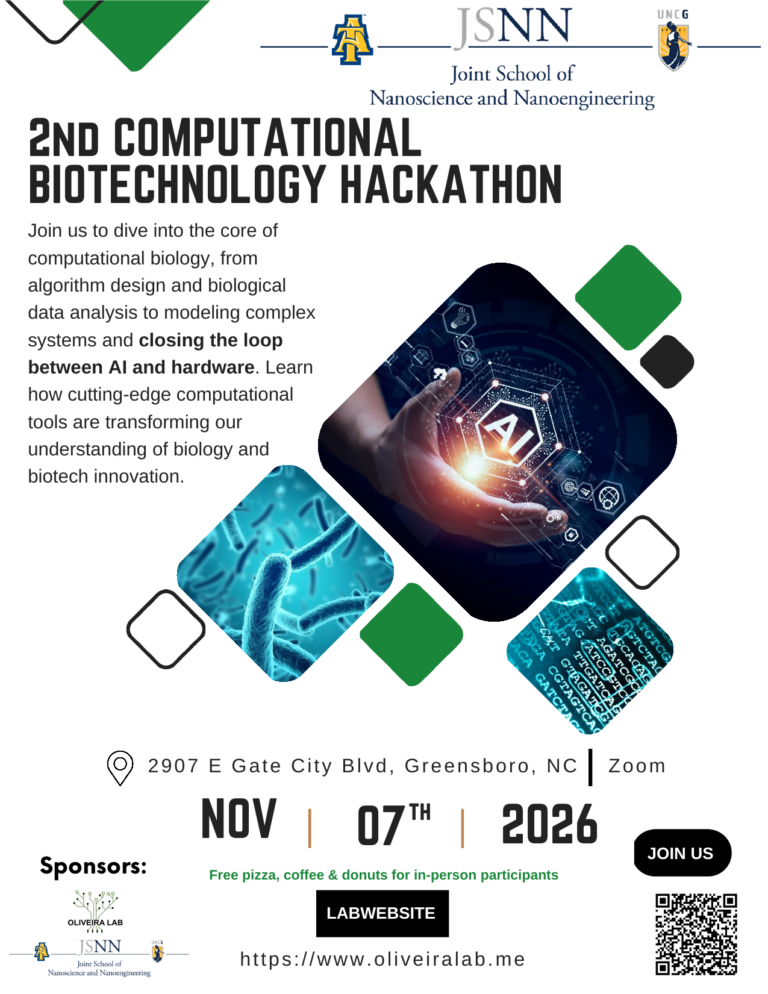
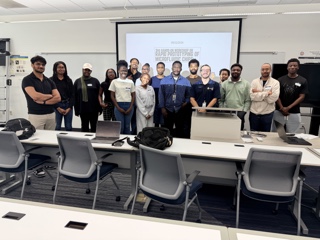
On Saturday, November 7, the Oliveira Lab hosted the 2nd Computational Biotechnology Hackathon at the Joint School of Nanoscience and Nanoengineering (JSNN). Participants joined us in person and on Zoom. Teams worked on three challenges built on real data from our lab. They tracked bacterial colonies as a biofilm broke apart, built a digital twin that predicts how an E. coli colony grows, and connected a bioreactor to a robotic arm so the arm moves
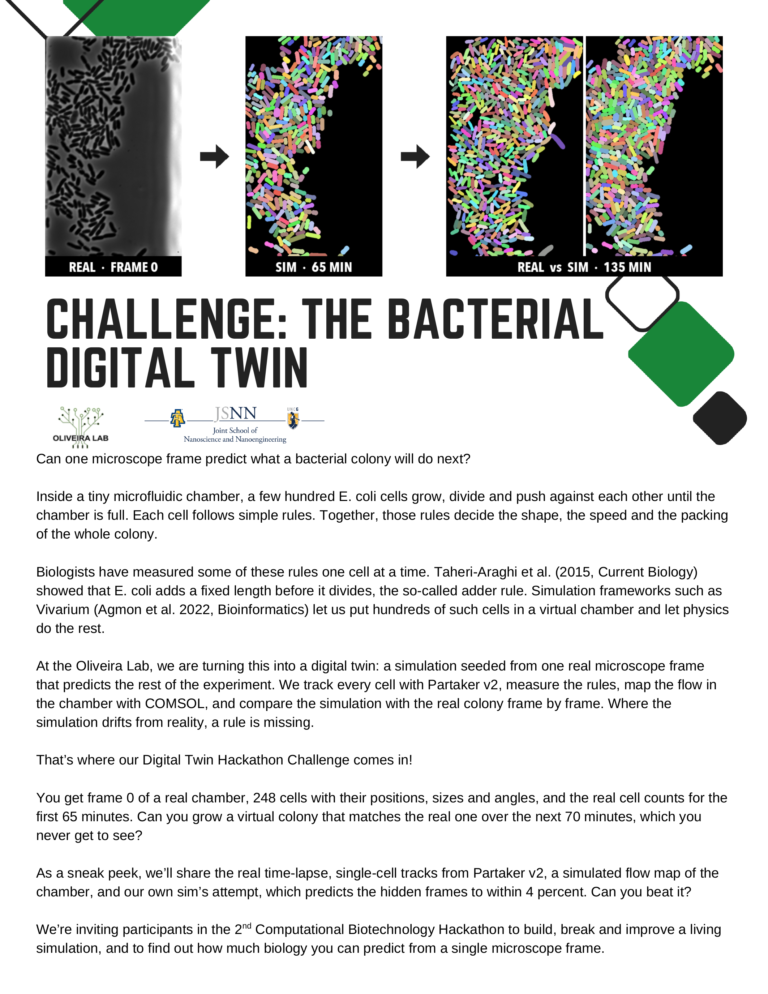
Can one microscope frame predict what a bacterial colony will do next? Inside a tiny microfluidic chamber, a few hundred E. coli cells grow, divide and push against each other until the chamber is full. Each cell follows simple rules. Together, those rules decide the shape, the speed and the packing of the whole colony. Biologists have measured some of these rules one cell at a time. Taheri-Araghi et al. (2015, Current Biology) showed that
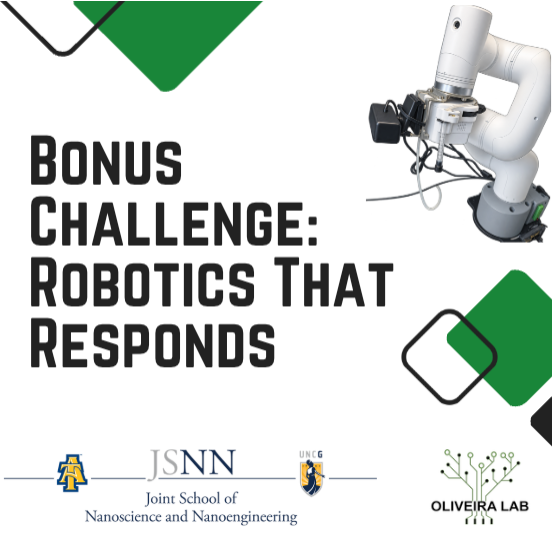
What if a bioreactor could tell a robotic arm when to move?Bioreactors help researchers monitor growing cultures, producing measurements that reveal how those cultures change over time. Connecting these measurements to automated equipment opens up another possibility: laboratory tools that respond to what they measure.At the Oliveira Lab, we’re exploring how computation can connect biological measurements with physical actions.That’s the idea behind our Robotics Challenge at the 2nd Computational Biotechnology Hackathon!As a sneak peek, this
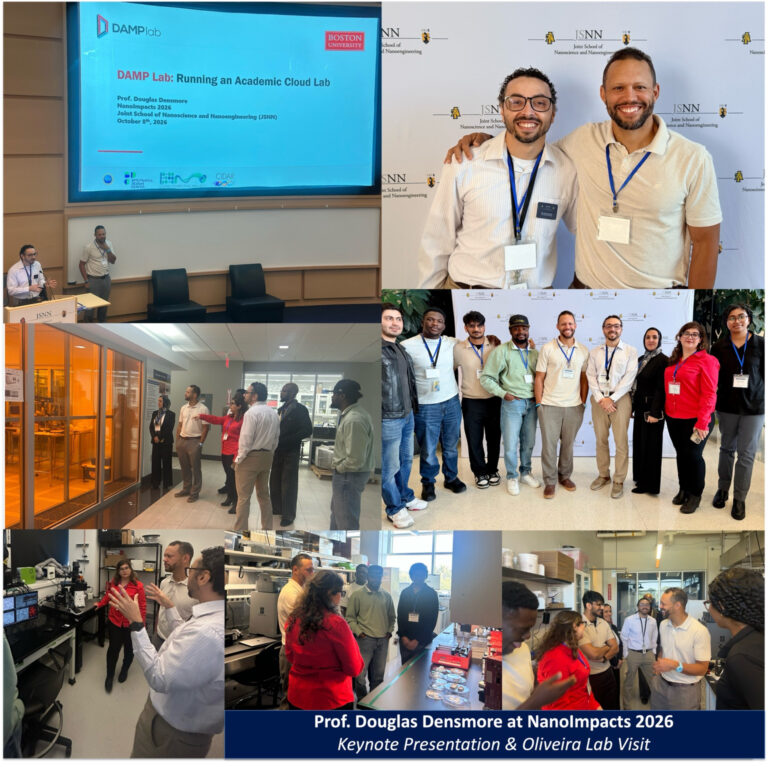
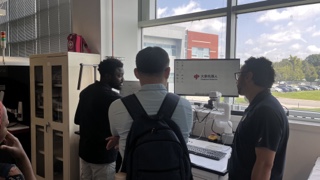
A Day of Scientific Exchange, Research Innovation, and Collaboration at JSNNThe Oliveira Lab was delighted to welcome Prof. Douglas Densmore, Distinguished Professor at Boston University and Director of the DAMP Lab, for a full day of scientific engagement during NanoImpacts 2026, held October 7–8, 2026, at the Joint School of Nanoscience and Nanoengineering (JSNN) in Greensboro, North Carolina.As one of the conference’s featured speakers, Prof. Densmore delivered a keynote presentation titled “DAMP Lab: Running an
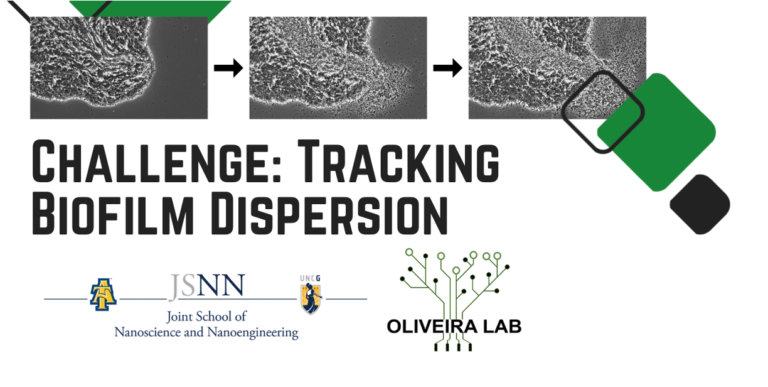
How can we track bacteria as they break away from their communities?Bacteria often form protective communities called biofilms. However, these bacteria don't always stay together. Through a process called biofilm dispersion, bacteria can break away and spread to new locations.A recent Nature Microbiology study by Chou et al. (2026), including Professor Gürol Süel, demonstrated how Bacillus subtilis biofilms can eject bacterial cells using mechanical forces generated by a self-produced hydrogel.At the Oliveira Lab, we're exploring
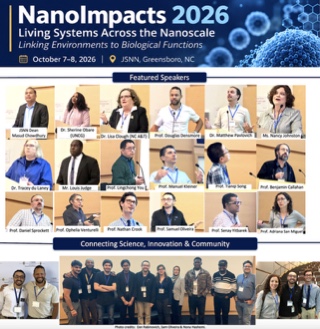
The Joint School of Nanoscience and Nanoengineering (JSNN) hosted NanoImpacts 2026: Living Systems Across the Nanoscale — Linking Environments to Biological Functions on October 7–8, 2026, bringing together researchers, academic leaders, and industry professionals for two days of scientific exchange, interdisciplinary discussions, and collaboration.The conference explored emerging advances at the intersection of nanoscience, synthetic biology, microbial engineering, biotechnology, and related fields. Through scientific presentations and discussions, participants examined innovative approaches to understanding, designing, and engineering
The Oliveira Lab is excited to host the 2nd Computational Biotechnology Hackathon, a one-day challenge at the intersection of biology and computation. This year we're diving into the core of computational biology, from algorithm design and biological data analysis to modeling complex systems and closing the loop between AI and hardware.Teams will design or simulate a computational biotechnology solution in a single day, with mentors from the lab guiding them along the way, and then
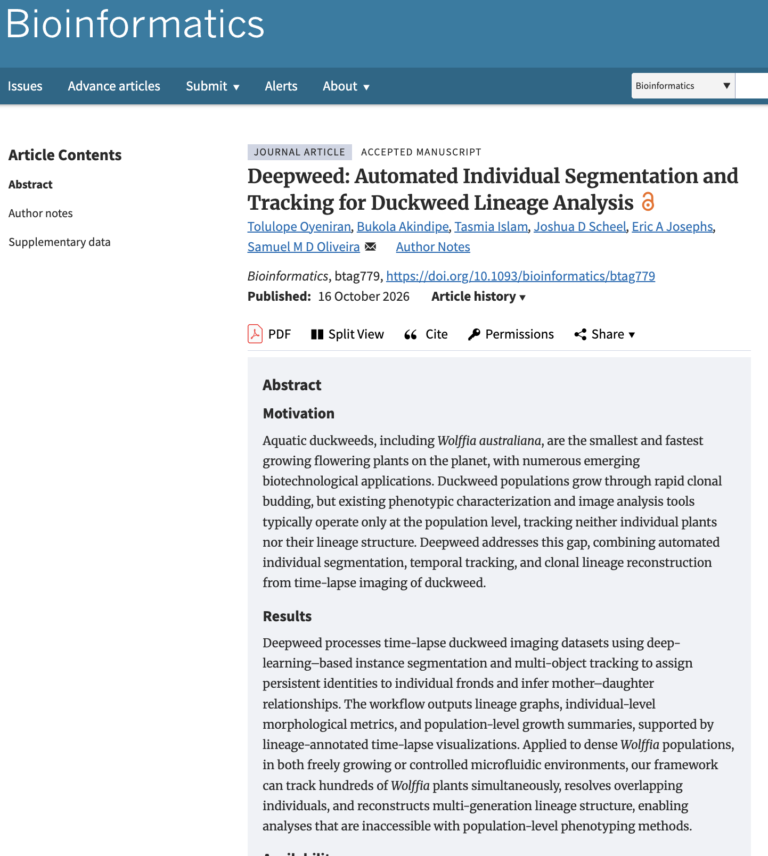
We’re excited to share that our paper, “Deepweed: Automated Individual Segmentation and Tracking for Duckweed Lineage Analysis,” is now published in Bioinformatics!Duckweeds like Wolffia australiana are the smallest and fastest-growing flowering plants on Earth, with growing potential in biotechnology. They multiply through rapid clonal budding, yet most existing image analysis tools only measure growth at the population level, missing individual plants and the family trees connecting them.Deepweed is a framework that fills that gap. Using
🔬 NanoImpacts 2026 is almost here! 🌱 What happens when nanoscience, biology, engineering, and the environment come together? Join us for NanoImpacts 2026: Living Systems Across the Nanoscale, Linking Environments to Biological Functions, happening October 7–8, 2026 at the Joint School of Nanoscience and Nanoengineering (JSNN) in Greensboro, NC. This two-day event will bring together researchers, scientists, engineers, students, and industry professionals to explore how nanoscale phenomena...
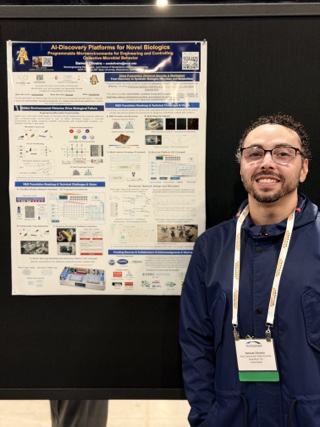
Dr. Samuel Oliveira represented the Oliveira Lab at the Defense TechConnect Innovation Summit & Expo 2026, held September 22–24 in National Harbor, Maryland. The conference brought together leaders from government, academia, industry, and the investment community to explore emerging technologies and dual-use innovations addressing national security challenges. During the conference, Dr. Oliveira presented the poster “Programmable Microenvironments for Engineering and Controlling Collective...
The Oliveira Lab hosted the 3rd Hands-on Workshop on Rapid Prototyping of Microfluidic Chips last Saturday, bringing together students and researchers for a full day that took participants from a blank CAD sketch to a working microfluidics device. The morning opened with introductory sessions led by Dr. Samuel M.D. Oliveira and our guest speaker Dr. João Costa of CNPEM, who joined from Brazil to discuss how microfluidics systems are transforming biological and biomedical research. Hannah...
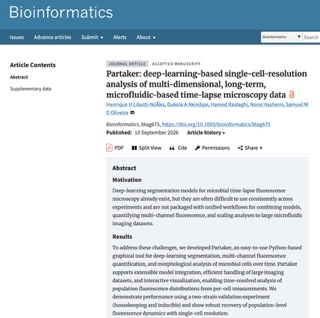
We're excited to share that our paper, "Partaker: deep-learning-based single-cell-resolution analysis of multi-dimensional, long-term, microfluidic-based time-lapse microscopy data," is officially published in Bioinformatics! This one has been a long time in the making, and we couldn't be more excited to finally share it. Partaker brings deep-learning segmentation, multi-channel fluorescence quantification, and scalable analysis together into one unified pipeline, solving a problem that's...
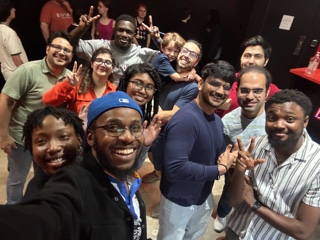
We had a great time stepping away from the lab and spending some time together at the escape room. It was a fun opportunity to work as a team in a completely different setting, solve puzzles, share ideas, and enjoy plenty of laughs along the way. Taking a break from research and our usual routine made the experience even more enjoyable, and it was a great way to spend time together outside of the lab and make some good memories as a team.
On August 28, the Oliveira Lab hosted Dr. He "Andrew" Fu, Assistant Professor of Biology at NC A&T, for a visit and discussion of his group's work. The Fu Lab studies how microbial communities interact and respond to changing environments, and how that ecology can be put to work. The project that stood out to us: developing cockroaches as living bioreactors for microplastic degradation. The insect gut already hosts a dense microbial consortium capable of breaking down difficult substrates,...
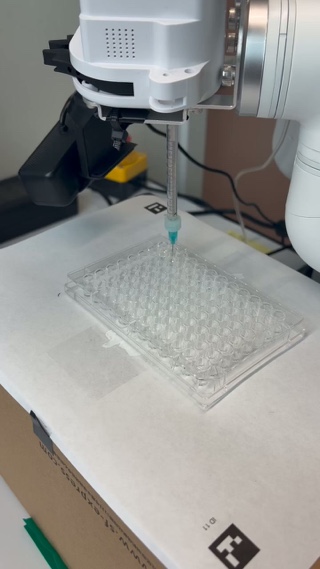
The Oliveira Lab is exploring robotic automation as part of our effort to build more autonomous experimental workflows. Our latest setup uses a robotic arm to perform repeatable sampling tasks, creating a foundation for integrating automated sample collection with microbial experiments. By coordinating the robotic arm with experimental hardware and software, we are working toward systems that can collect samples at defined locations and time points with less manual intervention. This could...
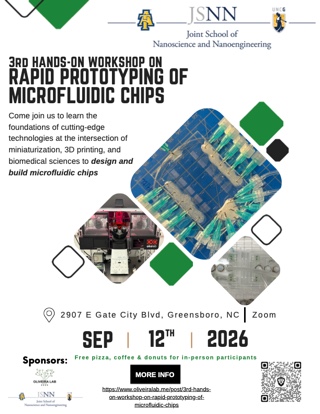
The Oliveira Lab at the Joint School of Nanoscience and Nanoengineering (JSNN) invites you to the 3rd Hands-on Workshop on Rapid Prototyping of Microfluidic Chips, taking place Saturday, September 12, 2026, from 9:00 AM to 4:30 PM at JSNN in Greensboro, NC. Microfluidics sits at the meeting point of miniaturization, precision fabrication, and the biomedical sciences. This one-day workshop covers that ground from both directions. The morning builds the concepts and the design skills; the...
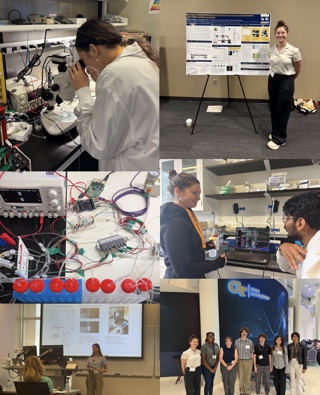
As Hannah Hobbs wraps up her time with the Oliveira Lab, we are excited to recognize the incredible work she has done to strengthen the lab’s experimental infrastructure. Throughout her time with us, Hannah played an important role in expanding our microfluidics capabilities. She developed and documented tubing and flow-routing workflows for microfluidic chips, contributed to new chip designs, and helped establish systems that will support more consistent and accessible experimentation across...
{"schema":1,"posts":{"586":"https:\/\/www.oliveiralab.me\/post\/dr-samuel-oliveira-to-present-at-duke-microbiome-center-seminar-series","582":"https:\/\/www.oliveiralab.me\/post\/2nd-computational-biotechnology-hackathon-2026","579":"https:\/\/www.oliveiralab.me\/post\/hackathon-challenge-spotlight-the-bacterial-digital-twin","575":"https:\/\/www.oliveiralab.me\/post\/hackathon-bonus-challenge-spotlight-robotics-that-responds","566":"https:\/\/www.oliveiralab.me\/post\/prof-douglas-densmore-visits-oliveira-lab-and-delivers-keynote-at-nanoimpacts-2026","562":"https:\/\/www.oliveiralab.me\/post\/hackathon-challenge-spotlight-tracking-biofilm-dispersion","548":"https:\/\/www.oliveiralab.me\/post\/nanoimpacts-2026-bringing-together-leading-minds-in-nanoscience-biotechnology-and-engineering","539":"https:\/\/www.oliveiralab.me\/post\/join-us-for-the-2nd-computational-biotechnology-hackathon","516":"https:\/\/www.oliveiralab.me\/post\/oliveira-lab-publishes-deepweed-a-framework-for-automated-individual-segmentation-and-lineage-tracking-of-duckweed","459":"https:\/\/www.oliveiralab.me\/post\/join-nanoimpacts-2026-living-systems-across-the-nanoscale","458":"https:\/\/www.oliveiralab.me\/post\/dr-oliveira-presents-oliveira-lab-research-at-defense-techconnect-2026","457":"https:\/\/www.oliveiralab.me\/post\/hands-on-workshop-on-rapid-prototyping-of-microfluidic-chips-at-oliveira-lab","456":"https:\/\/www.oliveiralab.me\/post\/oliveira-lab-publishes-partaker-a-tool-for-single-cell-bacterial-analysis-in-microfluidic-time-laps","455":"https:\/\/www.oliveiralab.me\/post\/oliveira-lab-escape-room-day","454":"https:\/\/www.oliveiralab.me\/post\/oliveira-lab-hosts-dr-he-fu-nc-a-t-biology","453":"https:\/\/www.oliveiralab.me\/post\/bringing-automation-to-the-lab-robotic-sampling-in-action","452":"https:\/\/www.oliveiralab.me\/post\/3rd-hands-on-workshop-on-rapid-prototyping-of-microfluidic-chips","451":"https:\/\/www.oliveiralab.me\/post\/hannah-hobbs-wraps-up-an-impactful-summer-in-the-oliveira-lab"}}{"schema":1,"posts":{"586":{"url":"https:\/\/www.oliveiralab.me\/post\/dr-samuel-oliveira-to-present-at-duke-microbiome-center-seminar-series"},"582":{"url":"https:\/\/www.oliveiralab.me\/post\/2nd-computational-biotechnology-hackathon-2026"},"579":{"url":"https:\/\/www.oliveiralab.me\/post\/hackathon-challenge-spotlight-the-bacterial-digital-twin"},"575":{"url":"https:\/\/www.oliveiralab.me\/post\/hackathon-bonus-challenge-spotlight-robotics-that-responds"},"566":{"url":"https:\/\/www.oliveiralab.me\/post\/prof-douglas-densmore-visits-oliveira-lab-and-delivers-keynote-at-nanoimpacts-2026"},"562":{"url":"https:\/\/www.oliveiralab.me\/post\/hackathon-challenge-spotlight-tracking-biofilm-dispersion"},"548":{"url":"https:\/\/www.oliveiralab.me\/post\/nanoimpacts-2026-bringing-together-leading-minds-in-nanoscience-biotechnology-and-engineering"},"539":{"url":"https:\/\/www.oliveiralab.me\/post\/join-us-for-the-2nd-computational-biotechnology-hackathon"},"516":{"url":"https:\/\/www.oliveiralab.me\/post\/oliveira-lab-publishes-deepweed-a-framework-for-automated-individual-segmentation-and-lineage-tracking-of-duckweed"},"459":{"url":"https:\/\/www.oliveiralab.me\/post\/join-nanoimpacts-2026-living-systems-across-the-nanoscale"},"458":{"url":"https:\/\/www.oliveiralab.me\/post\/dr-oliveira-presents-oliveira-lab-research-at-defense-techconnect-2026"},"457":{"url":"https:\/\/www.oliveiralab.me\/post\/hands-on-workshop-on-rapid-prototyping-of-microfluidic-chips-at-oliveira-lab"},"456":{"url":"https:\/\/www.oliveiralab.me\/post\/oliveira-lab-publishes-partaker-a-tool-for-single-cell-bacterial-analysis-in-microfluidic-time-laps"},"455":{"url":"https:\/\/www.oliveiralab.me\/post\/oliveira-lab-escape-room-day"},"454":{"url":"https:\/\/www.oliveiralab.me\/post\/oliveira-lab-hosts-dr-he-fu-nc-a-t-biology"},"453":{"url":"https:\/\/www.oliveiralab.me\/post\/bringing-automation-to-the-lab-robotic-sampling-in-action"},"452":{"url":"https:\/\/www.oliveiralab.me\/post\/3rd-hands-on-workshop-on-rapid-prototyping-of-microfluidic-chips"},"451":{"url":"https:\/\/www.oliveiralab.me\/post\/hannah-hobbs-wraps-up-an-impactful-summer-in-the-oliveira-lab"}}}{"schema":1,"posts":{"586":{"id":586,"url":"https:\/\/www.oliveiralab.me\/post\/dr-samuel-oliveira-to-present-at-duke-microbiome-center-seminar-series","title":"Dr. Samuel Oliveira to Present at Duke Microbiome Center Seminar Series","text":"Fresh from the Oliveira Lab: Dr. Samuel Oliveira to Present at Duke Microbiome Center Seminar Series\n\nWe are excited to share that Dr. Samuel Oliveira will present at the Duke Microbiome Center\u0027s 2026\u20132027 Research in Progress Seminar Series His talk, \u0022Programmable Environments for Artificial Microbial Communities,\u0022 will explore the co-design of engineered microbial communities and programmable environments to investigate microbial growth, communication, and collective behavior. The presentation will highlight how microfluidic platforms, automated environmental control, and digital twin technologies can be integrated to design, study, and predict microbial community dynamics, advancing our ability to engineer complex biological systems. The seminar provides an opportunity to share our ongoing research, exchange scientific ideas, and explore potential collaborations with the Duke research community.\n\nRead the full post: https:\/\/www.oliveiralab.me\/post\/dr-samuel-oliveira-to-present-at-duke-microbiome-center-seminar-series\n\n#Microfluidics"},"582":{"id":582,"url":"https:\/\/www.oliveiralab.me\/post\/2nd-computational-biotechnology-hackathon-2026","title":"2nd Computational Biotechnology Hackathon 2026","text":"Fresh from the Oliveira Lab: 2nd Computational Biotechnology Hackathon 2026\n\nOn Saturday, November 7, the Oliveira Lab hosted the 2nd Computational Biotechnology Hackathon at the Joint School of Nanoscience and Nanoengineering (JSNN). Participants joined us in person and on Zoom. Teams worked on three challenges built on real data from our lab. They tracked bacterial colonies as a biofilm broke apart, built a digital twin that predicts how an E. coli colony grows, and connected a bioreactor to a robotic arm so the arm moves when the culture reaches a set density. The day ended with team demos and judging. Congratulations to our first-place team, Brandon Townsend and Alex Williams, for the Robotics Challenge. Second place went to Md. Ashraful Islam, Mutiyat Usman and Kourosh Afshinjoo for the Digital Twin Challenge. Md. Ashraful Islam also won the Biofilm Dispersion Challenge.\n\nRead the full post: https:\/\/www.oliveiralab.me\/post\/2nd-computational-biotechnology-hackathon-2026\n\n#Biofilms #Biotechnology #Nanoscience #Hackathon"},"579":{"id":579,"url":"https:\/\/www.oliveiralab.me\/post\/hackathon-challenge-spotlight-the-bacterial-digital-twin","title":"Hackathon Challenge Spotlight: The Bacterial Digital Twin","text":"Fresh from the Oliveira Lab: Hackathon Challenge Spotlight: The Bacterial Digital Twin\n\nCan one microscope frame predict what a bacterial colony will do next? Inside a tiny microfluidic chamber, a few hundred E. coli cells grow, divide and push against each other until the chamber is full. Each cell follows simple rules. Together, those rules decide the shape, the speed and the packing of the whole colony. Biologists have measured some of these rules one cell at a time. Taheri-Araghi et al. (2015, Current Biology) showed that E. coli adds a fixed length before it divides, the so-called adder rule. Simulation frameworks such as Vivarium (Agmon et al. 2022, Bioinformatics) let us put hundreds of such cells in a virtual chamber and let physics do the rest.\n\nRead the full post: https:\/\/www.oliveiralab.me\/post\/hackathon-challenge-spotlight-the-bacterial-digital-twin\n\n#Microfluidics #Biotechnology #Nanoscience #Hackathon"},"575":{"id":575,"url":"https:\/\/www.oliveiralab.me\/post\/hackathon-bonus-challenge-spotlight-robotics-that-responds","title":"Hackathon Bonus Challenge Spotlight: Robotics That Responds","text":"Fresh from the Oliveira Lab: Hackathon Bonus Challenge Spotlight: Robotics That Responds\n\nWhat if a bioreactor could tell a robotic arm when to move? Bioreactors help researchers monitor growing cultures, producing measurements that reveal how those cultures change over time. Connecting these measurements to automated equipment opens up another possibility: laboratory tools that respond to what they measure. At the Oliveira Lab, we\u2019re exploring how computation can connect biological measurements with physical actions.\n\nRead the full post: https:\/\/www.oliveiralab.me\/post\/hackathon-bonus-challenge-spotlight-robotics-that-responds\n\n#Biotechnology #Nanoscience #Hackathon"},"566":{"id":566,"url":"https:\/\/www.oliveiralab.me\/post\/prof-douglas-densmore-visits-oliveira-lab-and-delivers-keynote-at-nanoimpacts-2026","title":"Prof. Douglas Densmore Visits Oliveira Lab and Delivers Keynote at NanoImpacts 2026","text":"Fresh from the Oliveira Lab: Prof. Douglas Densmore Visits Oliveira Lab and Delivers Keynote at NanoImpacts 2026\n\nA Day of Scientific Exchange, Research Innovation, and Collaboration at JSNN The Oliveira Lab was delighted to welcome Prof. Douglas Densmore, Distinguished Professor at Boston University and Director of the DAMP Lab, for a full day of scientific engagement during NanoImpacts 2026, held October 7\u20138, 2026, at the Joint School of Nanoscience and Nanoengineering (JSNN) in Greensboro, North Carolina. As one of the conference\u2019s featured speakers, Prof. Densmore delivered a keynote presentation titled \u201cDAMP Lab: Running an Academic Cloud Lab,\u201d highlighting innovative approaches to laboratory automation, cloud-based experimentation, and the integration of computational tools with experimental biology. His presentation offered valuable perspectives on how automated research infrastructure can enhance experimental reproducibility, accessibility, and efficiency while accelerating scientific discovery.\n\nRead the full post: https:\/\/www.oliveiralab.me\/post\/prof-douglas-densmore-visits-oliveira-lab-and-delivers-keynote-at-nanoimpacts-2026\n\n#Microfluidics #Biofilms #SyntheticBiology #Biotechnology #Automation"},"562":{"id":562,"url":"https:\/\/www.oliveiralab.me\/post\/hackathon-challenge-spotlight-tracking-biofilm-dispersion","title":"Hackathon Challenge Spotlight: Tracking Biofilm Dispersion","text":"Fresh from the Oliveira Lab: Hackathon Challenge Spotlight: Tracking Biofilm Dispersion\n\nHow can we track bacteria as they break away from their communities? Bacteria often form protective communities called biofilms. However, these bacteria don\u0027t always stay together. Through a process called biofilm dispersion, bacteria can break away and spread to new locations. A recent Nature Microbiology study by Chou et al. (2026), including Professor G\u00fcrol S\u00fcel, demonstrated how Bacillus subtilis biofilms can eject bacterial cells using mechanical forces generated by a self-produced hydrogel.\n\nRead the full post: https:\/\/www.oliveiralab.me\/post\/hackathon-challenge-spotlight-tracking-biofilm-dispersion\n\n#Microfluidics #Biofilms #Biotechnology #Nanoscience #Hackathon"},"548":{"id":548,"url":"https:\/\/www.oliveiralab.me\/post\/nanoimpacts-2026-bringing-together-leading-minds-in-nanoscience-biotechnology-and-engineering","title":"NanoImpacts 2026: Bringing Together Leading Minds in Nanoscience, Biotechnology, and Engineering","text":"Fresh from the Oliveira Lab: NanoImpacts 2026: Bringing Together Leading Minds in Nanoscience, Biotechnology, and Engineering\n\nThe Joint School of Nanoscience and Nanoengineering (JSNN) hosted NanoImpacts 2026: Living Systems Across the Nanoscale \u2014 Linking Environments to Biological Functions on October 7\u20138, 2026, bringing together researchers, academic leaders, and industry professionals for two days of scientific exchange, interdisciplinary discussions, and collaboration. The conference explored emerging advances at the intersection of nanoscience, synthetic biology, microbial engineering, biotechnology, and related fields. Through scientific presentations and discussions, participants examined innovative approaches to understanding, designing, and engineering biological systems across multiple scales. Scientific Program and Distinguished Speakers\n\nRead the full post: https:\/\/www.oliveiralab.me\/post\/nanoimpacts-2026-bringing-together-leading-minds-in-nanoscience-biotechnology-and-engineering\n\n#SyntheticBiology #Biotechnology #Nanoscience"},"539":{"id":539,"url":"https:\/\/www.oliveiralab.me\/post\/join-us-for-the-2nd-computational-biotechnology-hackathon","title":"Join Us for the 2nd Computational Biotechnology Hackathon","text":"Fresh from the Oliveira Lab: Join Us for the 2nd Computational Biotechnology Hackathon\n\nThe Oliveira Lab is excited to host the 2nd Computational Biotechnology Hackathon, a one-day challenge at the intersection of biology and computation. This year we\u0027re diving into the core of computational biology, from algorithm design and biological data analysis to modeling complex systems and closing the loop between AI and hardware. Teams will design or simulate a computational biotechnology solution in a single day, with mentors from the lab guiding them along the way, and then present their work to a panel of judges. \ud83d\udcc5 Date: Saturday, November 7, 2026\n\nRead the full post: https:\/\/www.oliveiralab.me\/post\/join-us-for-the-2nd-computational-biotechnology-hackathon\n\n#Biotechnology #Nanoscience #Hackathon"},"516":{"id":516,"url":"https:\/\/www.oliveiralab.me\/post\/oliveira-lab-publishes-deepweed-a-framework-for-automated-individual-segmentation-and-lineage-tracking-of-duckweed","title":"Oliveira Lab Publishes Deepweed: A Framework for Automated Individual Segmentation and Lineage Tracking of Duckweed","text":"Fresh from the Oliveira Lab: Oliveira Lab Publishes Deepweed: A Framework for Automated Individual Segmentation and Lineage Tracking of Duckweed\n\nWe\u2019re excited to share that our paper, \u201cDeepweed: Automated Individual Segmentation and Tracking for Duckweed Lineage Analysis,\u201d is now published in Bioinformatics! Duckweeds like Wolffia australiana are the smallest and fastest-growing flowering plants on Earth, with growing potential in biotechnology. They multiply through rapid clonal budding, yet most existing image analysis tools only measure growth at the population level, missing individual plants and the family trees connecting them. Deepweed is a framework that fills that gap. Using deep-learning-based instance segmentation and multi-object tracking, it follows individual fronds across time-lapse images, assigns each one a persistent identity, and reconstructs mother-daughter relationships. The pipeline outputs lineage graphs, individual morphological metrics, and population growth summaries, along with lineage-annotated time-lapse videos. Applied to dense Wolffia populations, both free-growing and in microfluidic devices, Dee\u2026\n\nRead the full post: https:\/\/www.oliveiralab.me\/post\/oliveira-lab-publishes-deepweed-a-framework-for-automated-individual-segmentation-and-lineage-tracking-of-duckweed\n\n#Duckweed #Microfluidics #Biotechnology #LineageTracking #ImageSegmentation"},"459":{"id":459,"url":"https:\/\/www.oliveiralab.me\/post\/join-nanoimpacts-2026-living-systems-across-the-nanoscale","title":"Join NanoImpacts 2026: Living Systems Across the Nanoscale","text":"Fresh from the Oliveira Lab: Join NanoImpacts 2026: Living Systems Across the Nanoscale\n\n\ud83d\udd2c NanoImpacts 2026 is almost here! \ud83c\udf31 What happens when nanoscience, biology, engineering, and the environment come together? Join us for NanoImpacts 2026: Living Systems Across the Nanoscale, Linking Environments to Biological Functions, happening October 7\u20138, 2026 at the Joint School of Nanoscience and Nanoengineering (JSNN) in Greensboro, NC.\n\nRead the full post: https:\/\/www.oliveiralab.me\/post\/join-nanoimpacts-2026-living-systems-across-the-nanoscale\n\n#Nanoscience"},"458":{"id":458,"url":"https:\/\/www.oliveiralab.me\/post\/dr-oliveira-presents-oliveira-lab-research-at-defense-techconnect-2026","title":"Dr. Oliveira Presents Oliveira Lab Research at Defense TechConnect 2026","text":"Fresh from the Oliveira Lab: Dr. Oliveira Presents Oliveira Lab Research at Defense TechConnect 2026\n\nDr. Samuel Oliveira represented the Oliveira Lab at the Defense TechConnect Innovation Summit \u0026 Expo 2026, held September 22\u201324 in National Harbor, Maryland. The conference brought together leaders from government, academia, industry, and the investment community to explore emerging technologies and dual-use innovations addressing national security challenges. During the conference, Dr. Oliveira presented the poster \u201cProgrammable Microenvironments for Engineering and Controlling Collective Microbial Behavior\u201d\u00a0as part of the Biotech \u0026 Medical\u00a0poster program. The work highlights the Oliveira Lab\u2019s efforts to develop programmable experimental platforms that combine microfluidics and bioreactor networks, high-content imaging, predictive modeling, and digital twins\u00a0to better understand and control collective microbial behavior.\n\nRead the full post: https:\/\/www.oliveiralab.me\/post\/dr-oliveira-presents-oliveira-lab-research-at-defense-techconnect-2026\n\n#Microfluidics #Biofilms #Bioengineering #Biotechnology"},"457":{"id":457,"url":"https:\/\/www.oliveiralab.me\/post\/hands-on-workshop-on-rapid-prototyping-of-microfluidic-chips-at-oliveira-lab","title":"Hands-on Workshop on Rapid Prototyping of Microfluidic Chips at Oliveira Lab","text":"Fresh from the Oliveira Lab: Hands-on Workshop on Rapid Prototyping of Microfluidic Chips at Oliveira Lab\n\nThe Oliveira Lab hosted the 3rd Hands-on Workshop on Rapid Prototyping of Microfluidic Chips last Saturday, bringing together students and researchers for a full day that took participants from a blank CAD sketch to a working microfluidics device. The morning opened with introductory sessions led by Dr. Samuel M.D. Oliveira and our guest speaker Dr. Jo\u00e3o Costa of CNPEM, who joined from Brazil to discuss how microfluidics systems are transforming biological and biomedical research. Hannah Hobbs shared what she built and learned during a summer of research in the Oliveira Lab, and Tolulope Oyeniran covered the techniques behind rapid prototyping before leading a guided Fusion 360 design session.\n\nRead the full post: https:\/\/www.oliveiralab.me\/post\/hands-on-workshop-on-rapid-prototyping-of-microfluidic-chips-at-oliveira-lab\n\n#Microfluidics"},"456":{"id":456,"url":"https:\/\/www.oliveiralab.me\/post\/oliveira-lab-publishes-partaker-a-tool-for-single-cell-bacterial-analysis-in-microfluidic-time-laps","title":"Oliveira Lab Publishes Partaker: A Tool for Single-Cell Bacterial Analysis in Microfluidic Time-Lapse Imaging","text":"Fresh from the Oliveira Lab: Oliveira Lab Publishes Partaker: A Tool for Single-Cell Bacterial Analysis in Microfluidic Time-Lapse Imaging\n\nWe\u0027re excited to share that our paper, \u0022Partaker: deep-learning-based single-cell-resolution analysis of multi-dimensional, long-term, microfluidic-based time-lapse microscopy data,\u0022 is officially published in Bioinformatics! This one has been a long time in the making, and we couldn\u0027t be more excited to finally share it. Partaker brings deep-learning segmentation, multi-channel fluorescence quantification, and scalable analysis together into one unified pipeline, solving a problem that\u0027s frustrated microfluidic imaging researchers for years: tools that don\u0027t generalize or scale across datasets. Huge congratulations to lead author Henrique Libutti-Nunez\u00a0and to co-authors Bukola Akindipe, Hamed Rastaghi, Nona Hashemi, and Samuel Oliveira\u00a0for the incredible work behind this publication.\n\nRead the full post: https:\/\/www.oliveiralab.me\/post\/oliveira-lab-publishes-partaker-a-tool-for-single-cell-bacterial-analysis-in-microfluidic-time-laps\n\n#Microfluidics #ImageSegmentation"},"455":{"id":455,"url":"https:\/\/www.oliveiralab.me\/post\/oliveira-lab-escape-room-day","title":"Oliveira Lab Escape Room Day","text":"Fresh from the Oliveira Lab: Oliveira Lab Escape Room Day\n\nWe had a great time stepping away from the lab and spending some time together at the escape room. It was a fun opportunity to work as a team in a completely different setting, solve puzzles, share ideas, and enjoy plenty of laughs along the way. Taking a break from research and our usual routine made the experience even more enjoyable, and it was a great way to spend time together outside of the lab and make some good memories as a team.\n\nRead the full post: https:\/\/www.oliveiralab.me\/post\/oliveira-lab-escape-room-day"},"454":{"id":454,"url":"https:\/\/www.oliveiralab.me\/post\/oliveira-lab-hosts-dr-he-fu-nc-a-t-biology","title":"Oliveira Lab Hosts Dr. He Fu, NC A\u0026T Biology","text":"Fresh from the Oliveira Lab: Oliveira Lab Hosts Dr. He Fu, NC A\u0026T Biology\n\nOn August 28, the Oliveira Lab hosted Dr. He \u0022Andrew\u0022 Fu, Assistant Professor of Biology at NC A\u0026T, for a visit and discussion of his group\u0027s work. The Fu Lab studies how microbial communities interact and respond to changing environments, and how that ecology can be put to work. The project that stood out to us: developing cockroaches as living bioreactors for microplastic degradation. The insect gut already hosts a dense microbial consortium capable of breaking down difficult substrates, and the lab is asking whether that consortium can be directed at plastics. It reframes a pest as a waste-processing platform. His group also works on environmental microbiomes linked to climate processes and on soil phages as tools for microbial control and biotechnology. We are excited about the collaborations that could come out of this visit.\n\nRead the full post: https:\/\/www.oliveiralab.me\/post\/oliveira-lab-hosts-dr-he-fu-nc-a-t-biology\n\n#Biotechnology"},"453":{"id":453,"url":"https:\/\/www.oliveiralab.me\/post\/bringing-automation-to-the-lab-robotic-sampling-in-action","title":"Bringing Automation to the Lab: Robotic Sampling in Action","text":"Fresh from the Oliveira Lab: Bringing Automation to the Lab: Robotic Sampling in Action\n\nThe Oliveira Lab is exploring robotic automation as part of our effort to build more autonomous experimental workflows. Our latest setup uses a robotic arm to perform repeatable sampling tasks, creating a foundation for integrating automated sample collection with microbial experiments. By coordinating the robotic arm with experimental hardware and software, we are working toward systems that can collect samples at defined locations and time points with less manual intervention. This could make long-duration experiments easier to standardize while creating new opportunities to connect physical laboratory actions with real-time measurements and computational decision-making. This work supports the lab\u2019s broader goal of combining robotics, automation, microfluidics, and computational tools to develop smarter experimental platforms for studying and engineering microbial systems.\n\nRead the full post: https:\/\/www.oliveiralab.me\/post\/bringing-automation-to-the-lab-robotic-sampling-in-action\n\n#Microfluidics #Automation"},"452":{"id":452,"url":"https:\/\/www.oliveiralab.me\/post\/3rd-hands-on-workshop-on-rapid-prototyping-of-microfluidic-chips","title":"3rd Hands-on Workshop on Rapid Prototyping of Microfluidic Chips","text":"Fresh from the Oliveira Lab: 3rd Hands-on Workshop on Rapid Prototyping of Microfluidic Chips\n\nThe Oliveira Lab at the Joint School of Nanoscience and Nanoengineering (JSNN) invites you to the 3rd Hands-on Workshop on Rapid Prototyping of Microfluidic Chips, taking place Saturday, September 12, 2026, from 9:00 AM to 4:30 PM at JSNN in Greensboro, NC. Microfluidics sits at the meeting point of miniaturization, precision fabrication, and the biomedical sciences. This one-day workshop covers that ground from both directions. The morning builds the concepts and the design skills; the afternoon puts you at the bench, where you will fabricate a chip and watch fluid move through something you built yourself. What this workshop offers\n\nRead the full post: https:\/\/www.oliveiralab.me\/post\/3rd-hands-on-workshop-on-rapid-prototyping-of-microfluidic-chips\n\n#Microfluidics #Nanoscience"},"451":{"id":451,"url":"https:\/\/www.oliveiralab.me\/post\/hannah-hobbs-wraps-up-an-impactful-summer-in-the-oliveira-lab","title":"Hannah Hobbs Wraps Up an Impactful Summer in the Oliveira Lab","text":"Fresh from the Oliveira Lab: Hannah Hobbs Wraps Up an Impactful Summer in the Oliveira Lab\n\nAs Hannah Hobbs wraps up her time with the Oliveira Lab, we are excited to recognize the incredible work she has done to strengthen the lab\u2019s experimental infrastructure. Throughout her time with us, Hannah played an important role in expanding our microfluidics capabilities. She developed and documented tubing and flow-routing workflows for microfluidic chips, contributed to new chip designs, and helped establish systems that will support more consistent and accessible experimentation across the lab. Hannah also supported the testing of electrode-based experimental setups, helping lay the groundwork for future projects combining microfluidic control with electrical measurements. Hannah\u2019s work has created a strong foundation that will continue supporting the lab\u2019s research well beyond her time here. We are incredibly grateful for her initiative, creativity, and willingness to take on challenging new projects. We wish her all the best in what comes next and look forward to seeing everyt\u2026\n\nRead the full post: https:\/\/www.oliveiralab.me\/post\/hannah-hobbs-wraps-up-an-impactful-summer-in-the-oliveira-lab\n\n#Microfluidics"}},"article":null}